
If you have a metal roof in Maine, you probably need snow guards anywhere sliding snow could land on people or things: over doors, walkways, decks, driveways, lower roofs and gutters. Snow guards on a metal roof hold the snow in place so it melts off gradually or falls in smaller pieces, instead of coming down all at once.
Below, we’ll explain why snow slides off metal the way it does, where snow guards go, the main types, and what to know about adding them to a roof you already have.
Why snow slides off a metal roof all at once
Metal is smooth, so snow has little to grip. When the sun or a bit of warmth from below softens the bottom layer, the whole blanket of snow can let go and slide off in one heavy sheet.
That’s part of why metal roofs do so well in Maine: they don’t hold snow for long. But a sheet of wet, heavy snow dropping off the eaves can:
Bury front steps and block a doorway
Dent cars and damage anything parked below
Crush deck railings, shrubs and plantings
Tear gutters off the fascia
Pound a lower roof or porch roof below
Hurt someone walking underneath
Valleys need care too. According to metal panel manufacturer Fabral, sliding snow can bend standing seams over where it drifts into a valley, which can lead to leaks.
Where snow guards go on a metal roof in Maine
Snow guards belong above any spot where falling snow could cause harm or damage. On a typical Midcoast home, that usually means:
Over entry doors and walkways
Above decks, porches and patios
Over driveways and parking spots
Above lower roofs, like a porch roof or an attached ell
Along eaves with gutters you want to keep
Above valleys, where drifting snow can damage the seams
Where you might not need them: if snow slides onto open lawn where nobody walks, letting it fall is often the better choice, because it takes weight off the roof. Very steep and very shallow roofs behave differently too. Fabral notes that snow tends to slide off very steep roofs before it builds up, while on very low slopes it tends to melt in place.
How they’re laid out: the pattern depends on the roof’s pitch, how long the panels are and how much snow the area gets. Manufacturers publish layout guidance, and it usually calls for the first row at or just above the exterior wall. On longer roofs, several rows spread up the slope hold snow better than one row at the edge, because snow can build speed on a long run before it hits a single row.
Types of snow guards
Snow guards come in two main styles, and how they attach matters as much as which style you pick.
Pad-style guards. Individual guards placed in a staggered pattern across the roof. Each one holds back a section of snow.
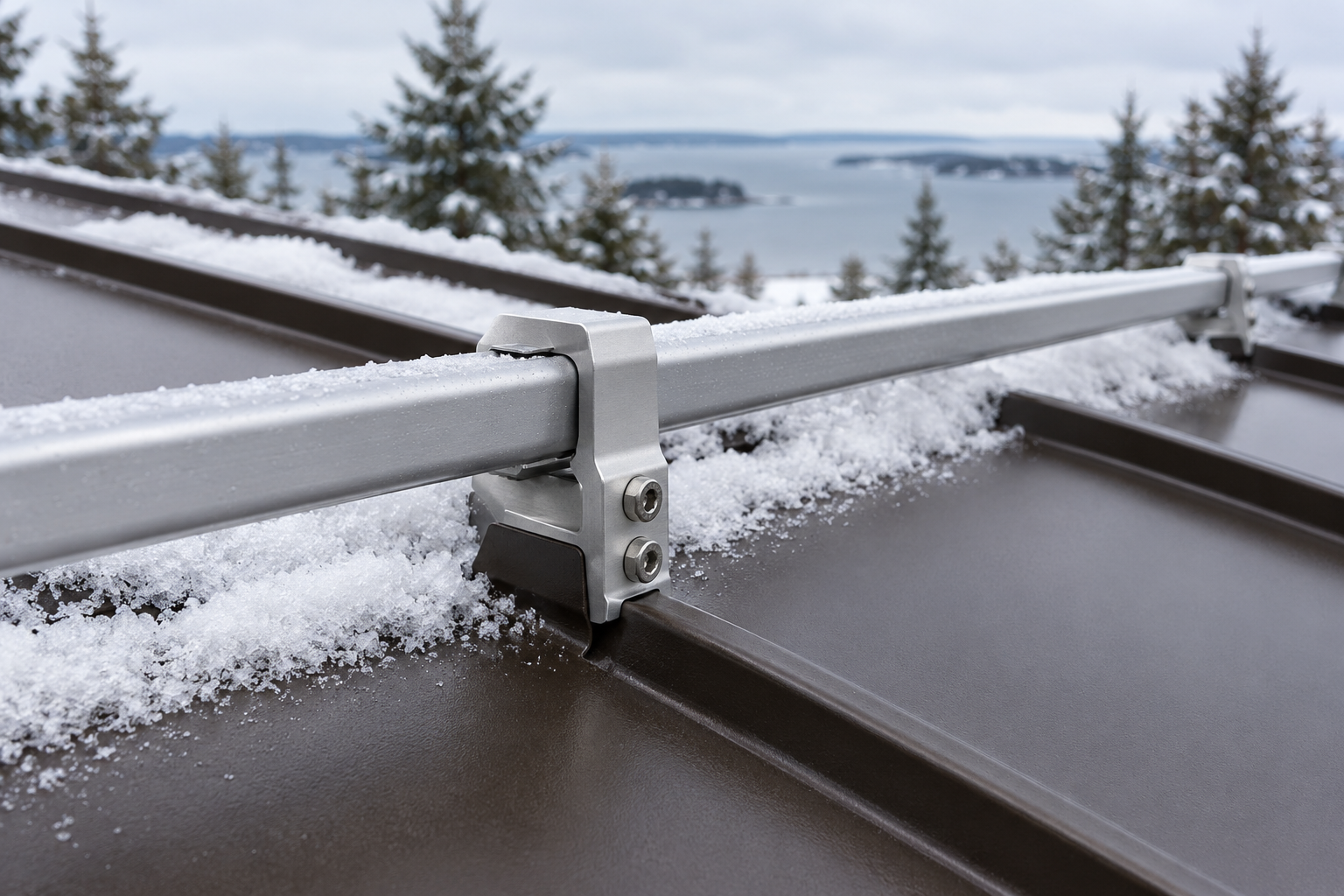
Rail or bar systems. One or two continuous rails (bars or pipes) running across the roof, held up by brackets. They work like a low fence and give a clean, uniform look.
On standing seam roofs, clamp-on attachment is the norm. Standing seam panels have raised seams where the panels lock together, and the fasteners are hidden. Clamp-on snow guards grip those seams without piercing the panels. Fabral recommends clamped-on guards over screwed-on ones for standing seam, because screws through the panel can hold back the normal expansion and contraction the panels are designed for. The clamp has to match the seam’s shape and be installed to the manufacturer’s instructions.
On screw-down metal roofs, there are no raised seams to clamp onto, so snow guards are screwed through the panel with a sealant underneath. If you’re weighing the two styles of metal roof, our guide to screw-down vs. standing seam metal roofs compares them.
Guards that are only glued on tend to come loose, so mechanical attachment (clamps or screws) is the way to go.
Adding snow guards to an existing metal roof
Yes, you can add snow guards to a metal roof that’s already on. It’s common for people to add them after their first winter, once they see where the snow comes down.
A few things to know before you do:
The roof will carry more snow. That’s the whole point, but it means more weight on the structure. Most roofs are built for it, but an older building or a long, heavy winter is worth thinking about.
The panels feel the extra drag. Holding snow puts extra force on the panels and their fasteners, so the system should be checked when guards go on.
The right clamp matters. Each seam profile needs a matching clamp, so it helps to know what panel you have.
The easiest time to plan snow guards is when the roof goes on. If you’re considering a new standing seam metal roof, we’d talk through where snow will fall and plan the guards with you. Our post on metal roofing on the Maine coast covers how metal holds up to salt air and wind.
Frequently asked questions
Do asphalt shingle roofs need snow guards?
Usually not. The rough, granular surface of shingles holds snow in place far better than smooth metal. Snow guards are mainly a metal roof question, and our comparison of asphalt vs. metal roofing covers the other differences.
Will snow guards damage my standing seam roof?
Not when they’re the right kind and installed correctly. Clamp-on guards grip the seams without piercing the panels. The clamp needs to match your seam profile and be fastened to the manufacturer’s instructions.
Do snow guards cause ice dams?
Not on their own. Ice dams start with heat escaping into the attic, which melts snow that then refreezes at the cold eaves. Holding snow on the roof does keep more of it near the edge, so good attic insulation and ventilation still matter.
How many snow guards does my roof need?
It depends on your roof’s pitch, the length of the panels and the local snow load. Manufacturers publish layout guidance for each system, and longer, steeper roofs usually need more than one row.
Planning snow guards for your metal roof
Snow guards are a small part of a metal roof that make a big difference to everything below it. If you have questions about snow guards for your home, we’d be happy to talk it through. Reach out here or give us a call at (207) 200-1053.